In today’s competitive online world, businesses cannot survive without proper visibility on search engines. Whether you run a service business, blog, or e-commerce store, your SEO website must be optimized correctly to rank on Google. That’s where On-Page SEO becomes the backbone of the best digital marketing strategy.
On-Page SEO refers to optimizing individual web pages so they rank higher and earn relevant traffic. Unlike off-page SEO, which focuses on backlinks, on-page SEO gives you full control over your SEO website performance.
This complete checklist will help you understand every critical element required for optimization in 2026.
What Is On-Page SEO?
On-Page SEO involves optimizing elements directly on your website to improve search engine rankings. It includes:
- Content optimization
- Keyword placement
- Title tags
- Meta descriptions
- URL structure
- Internal linking
- Image optimization
- Technical improvements
A properly optimized SEO website becomes the foundation of the best digital marketing framework because it ensures long-term organic growth.
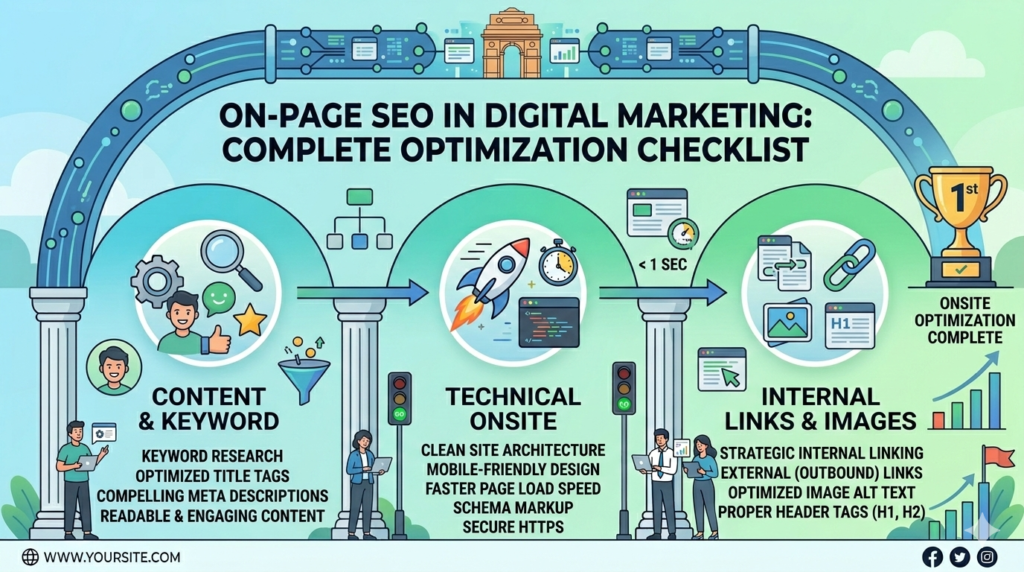
Why On-Page SEO Is Important in Digital Marketing
Here’s why On-Page SEO is essential:
| Benefit | Impact on Website |
|---|---|
| Better Ranking | Higher visibility on Google |
| Improved User Experience | Lower bounce rate |
| Increased Traffic | More organic visitors |
| Higher Conversions | Better engagement |
| Strong Website Authority | Long-term digital growth |
Without proper on-page SEO, even the most expensive advertising campaigns cannot deliver sustainable results.
Complete On-Page SEO Optimization Checklist
Let’s break it into structured sections.
1️⃣ Keyword Research & Placement
Everything starts with the right keyword strategy.
Checklist:
✔ Identify primary keyword
✔ Add secondary keywords
✔ Use keywords naturally
✔ Maintain proper keyword density
✔ Avoid keyword stuffing
Your main keyword should appear in:
- Page title
- First 100 words
- At least one H2 heading
- Meta description
- URL
- Image alt text
Strategic keyword placement improves SEO performance and strengthens your best digital marketing execution.
2️⃣ Title Tag Optimization
The title tag is the first thing users see on Google.
Best Practices:
- Keep it under 60 characters
- Include your main keyword
- Make it engaging and clickable
- Avoid duplication
Example Structure:
Primary Keyword + Benefit + Year (Optional)
A strong title improves both SEO ranking and click-through rate.
3️⃣ Meta Description Optimization
Meta descriptions don’t directly impact SEO rankings but improve CTR (Click-Through Rate).
Checklist:
✔ 150–160 characters
✔ Include primary keyword
✔ Add call-to-action
✔ Keep it compelling
Higher CTR indirectly boosts your SEO website authority.
4️⃣ SEO-Friendly URL Structure
Clean URLs help search engines understand page content.
Good Example:
yourwebsite.com/on-page-seo-checklist
Bad Example:
yourwebsite.com/page?id=12345
URL Optimization Checklist:
✔ Short and simple
✔ Include keyword
✔ Avoid special characters
✔ Use hyphens instead of underscores
Optimized URLs support the best digital marketing structure for long-term growth.
5️⃣ Heading Structure (H1–H4)
Proper heading hierarchy improves readability and SEO clarity.
Structure Example:
H1 → Main Title
H2 → Section Headings
H3 → Subpoints
H4 → Supporting details
Rules:
✔ Only one H1 per page
✔ Include keyword in at least one H2
✔ Maintain logical hierarchy
This improves crawling and strengthens SEO signals.
6️⃣ Content Optimization
Content is the core of every SEO website.
Content Checklist:
✔ Minimum 800–1000 words
✔ Keyword naturally distributed
✔ Use bullet points
✔ Include tables
✔ Add FAQs
✔ Keep paragraphs short
Google prioritizes helpful, structured content. High-quality content is the backbone of the best digital marketing performance.
7️⃣ Internal Linking Strategy
Internal linking helps distribute authority across your website.
Checklist:
✔ Link to related blogs
✔ Use descriptive anchor text
✔ Avoid broken links
✔ Maintain logical structure
Example Flow:
Homepage
→ Service Page
→ Blog Article
→ Related Article
This strengthens your overall SEO ecosystem.
8️⃣ Image Optimization
Images can slow down your SEO website if not optimized.
Image Checklist:
✔ Compress images
✔ Use descriptive file names
✔ Add keyword-rich alt text
✔ Choose proper format (WebP preferred)
Image optimization improves loading speed, which is a critical SEO ranking factor.
9️⃣ Page Speed Optimization
Speed directly impacts ranking and user experience.
Speed Performance Impact:
1–2 Seconds → Excellent
3–4 Seconds → Acceptable
5+ Seconds → High bounce rate
To improve SEO performance:
✔ Minimize CSS & JavaScript
✔ Use caching
✔ Optimize hosting
✔ Enable lazy loading
Fast websites are essential for the best digital marketing success.
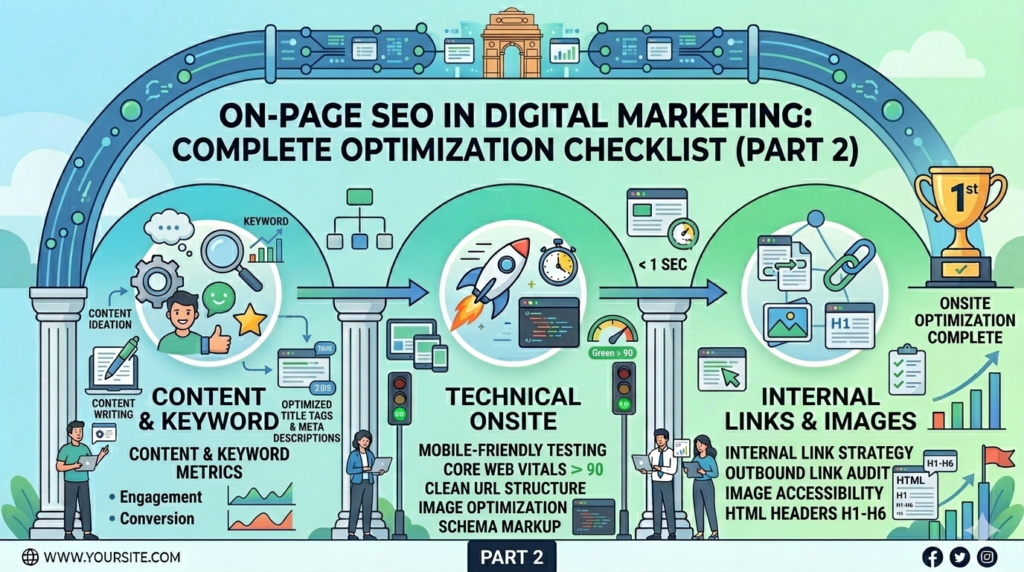
🔟 Mobile Optimization
Google uses mobile-first indexing.
Checklist:
✔ Responsive design
✔ Fast mobile loading
✔ Easy navigation
✔ Clickable buttons
✔ Readable font size
Without mobile optimization, your SEO website will struggle to rank in competitive markets.
1️⃣1️⃣ Technical SEO Basics
On-page SEO also includes technical elements.
Checklist:
✔ SSL certificate (HTTPS)
✔ XML sitemap
✔ Robots.txt file
✔ No duplicate content
✔ Proper canonical tags
Technical SEO ensures search engines can properly crawl and index your pages.
Common On-Page SEO Mistakes to Avoid
❌ Keyword stuffing
❌ Duplicate content
❌ Missing meta tags
❌ Slow loading speed
❌ Ignoring mobile optimization
❌ Poor internal linking
Avoiding these mistakes strengthens your website’s authority and improves the overall best digital marketing outcome.
On-Page SEO Workflow (Step-by-Step)
Research Keywords
→ Optimize Title & Meta
→ Structure Content
→ Add Internal Links
→ Optimize Images
→ Improve Speed
→ Test Mobile Version
→ Submit Sitemap
This workflow ensures every page on your SEO website is optimized properly.
Why On-Page SEO Is the Foundation of Digital Marketing
Think of it like this:
Paid Ads = Temporary Traffic
On-Page SEO = Long-Term Asset
When your pages rank organically, you generate consistent traffic without ongoing ad costs.
That’s why every successful brand prioritizes on-page SEO as part of the best digital marketing strategy.
Conclusion
On-Page SEO is not just about inserting keywords — it’s about building a structured, optimized, and user-friendly SEO website that search engines trust.
If you follow this complete optimization checklist, your website will:
- Rank higher on Google
- Attract quality traffic
- Improve user engagement
- Generate consistent leads
- Build long-term authority
In 2026 and beyond, businesses that focus on structured on-page SEO will dominate search results and create sustainable digital growth.